Almost every booth decision eventually comes down to the back. It is the tallest surface in the room, the part a guest leans against for ninety minutes, the part a server wipes down between seatings, and the part that ends up in the background of every photograph taken in the dining room.
There are three ways to finish it, and the catalog is split roughly evenly between them. Here is what each one is actually good at.
The quick version
| Finished wood | Laminate | Fully upholstered | |
|---|---|---|---|
| Reads as | Warm, traditional | Clean, contemporary | Soft, hospitality |
| Wipes down | Well | Best | Depends on the covering |
| Shows wear as | Scratches and dents | Edge chips | Scuffs and seam stress |
| Repair | Refinish in place | Replace the panel | Recover the panel |
| Best for | Dining rooms that want warmth | High-turn, high-wipe rooms | Rooms where comfort sells |
Nothing here is a ranking. All three are built on the same frame, and the frame is the part that decides whether a booth lasts.
Finished wood
A finished wood back is a real wood exterior, usually carried through to the trim, the crumb trough and the legs so the piece reads as one object. In the catalog it is the Cabriolet, Chalmette, Concord, Grovewood, Leeland, Monterey, Regal, Scarborough and Woodland.
Wood’s advantage is that it ages rather than fails. A scratch in a finished wood back is a scratch, and it can be sanded and refinished in place without taking the booth out of service for long. A room full of wood-backed booths that has been open five years looks used. The same room in a material that chips looks damaged.
The trade-off is maintenance attention. Wood wants to be cleaned with something that will not strip the finish, and it will show a ring if something wet sits on it long enough. In a room where the back takes a wipe-down twenty times a day, that adds up.
Laminate
Laminate is a hard, sealed surface over the substrate. In the catalog it is the Chalmette, Hamptons, Neon, Niagara, Regatta, Reno and Sheffield. The Sheffield is offered in laminate only.
This is the surface that handles abuse. It takes a wipe-down with whatever is on the cart, it does not absorb, and it does not need refinishing. We use a laminated finish on the cap strip of every booth for exactly this reason, because the cap strip is where guests touch the booth most and it has to take a decade of arm wear.
The trade-off is at the edges. A laminate surface does not scratch the way wood does, but it can chip at a corner, and a chip is not repairable the way a scratch is. The panel gets replaced. That is a cleaner repair than it sounds, but it is a replacement rather than a touch-up.
Fully upholstered
A fully upholstered back carries the covering across the outside as well as the inside. In the catalog that includes the Cabriolet, Hamptons, Monterey, Niagara, Orleans, Scarborough and Southern.
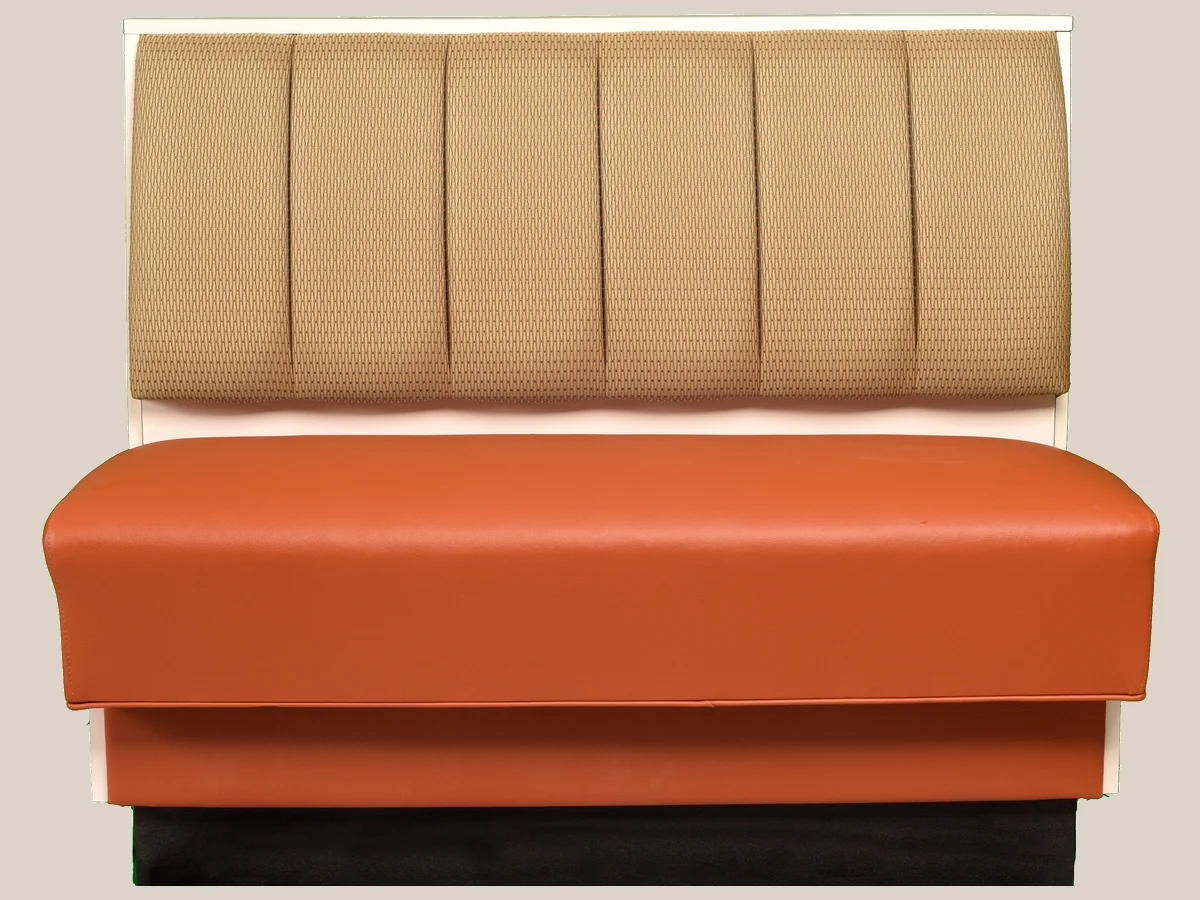
This is the one that changes how a room feels rather than how it looks. Upholstery absorbs sound, which matters more than most people expect in a hard-surfaced dining room. It is also the only one of the three where the back can carry a pattern, a contrast welt, or a treatment that ties the booths to the rest of the room.
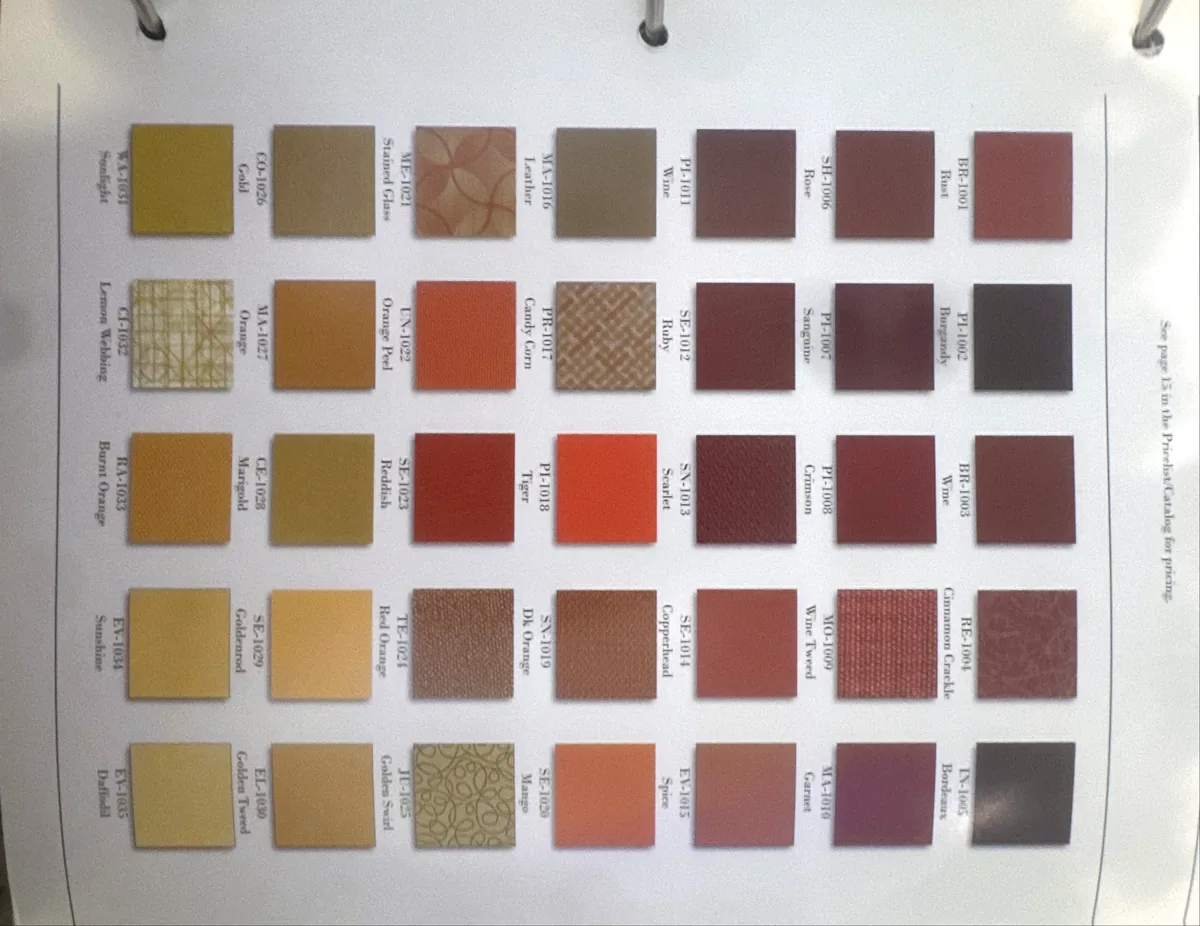
The trade-off is that the back now has the same service life as the covering on it, and the outside back is the surface most likely to meet a cart, a chair, or a vacuum. If you specify fully upholstered, specify the covering for the outside back as if it were a high-wear surface, because it is one.
The back treatment is a separate decision
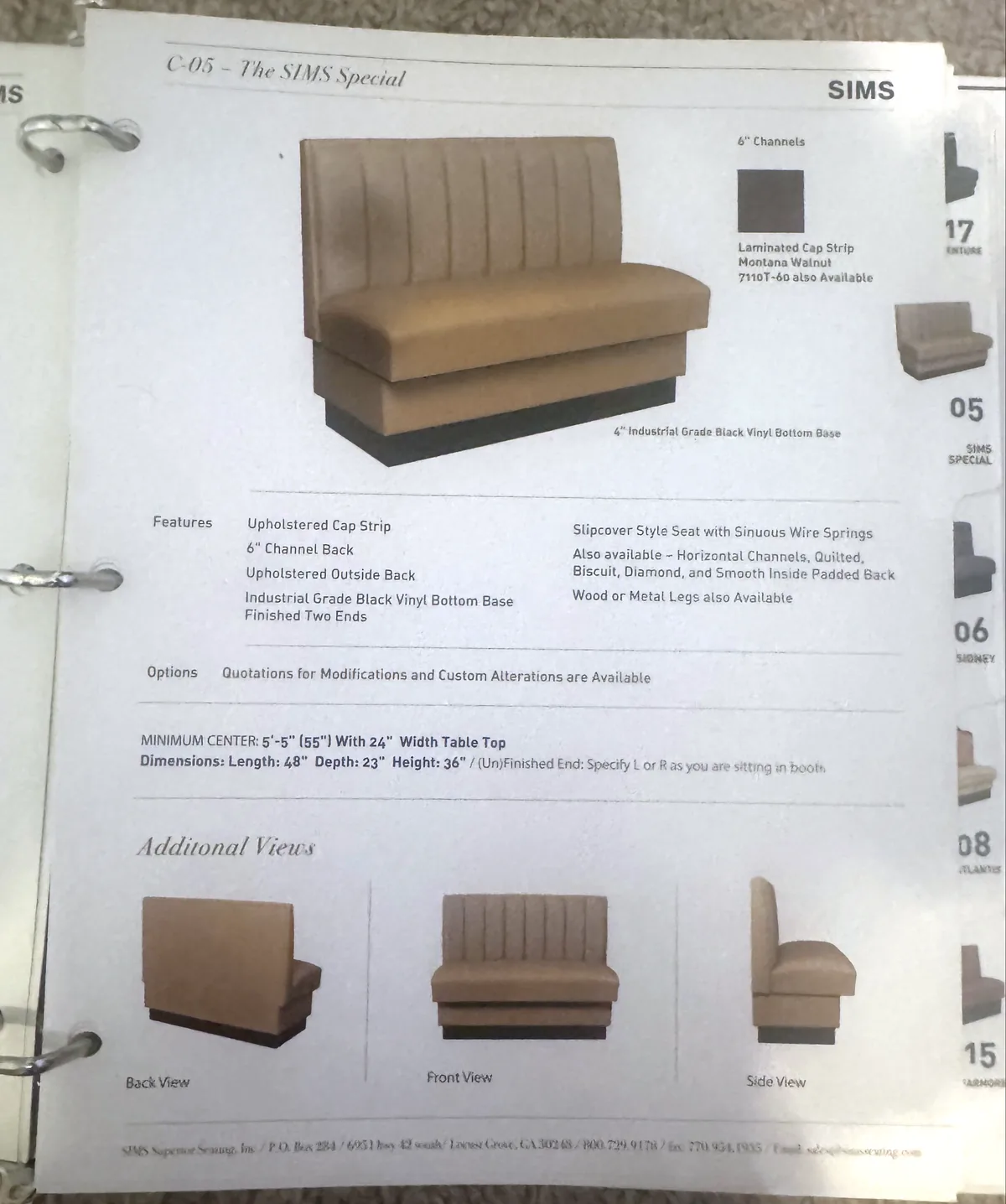
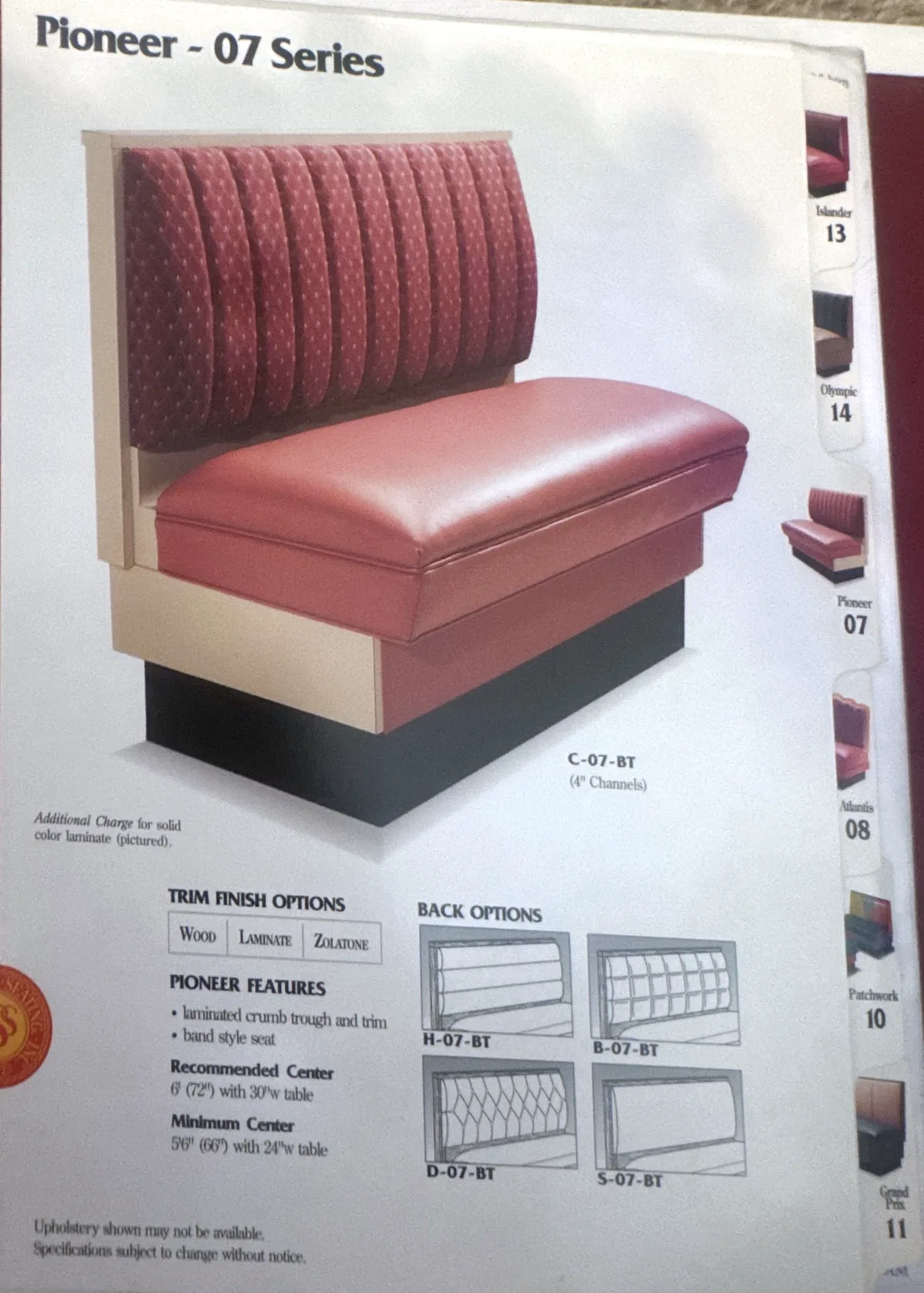
Material and treatment are often confused. The material is what the back is made of; the treatment is what the inside face does. The catalog offers smooth, vertical channel, horizontal channel, pulled button and headroll, and they vary by model rather than being universal.
A smooth back is the easiest to keep clean and the most contemporary. Channels, vertical or horizontal, add depth and hide wear patterns well because the eye reads the line rather than the surface. Pulled button is the most traditional and the most labor-intensive, and our buttons are hand-set rather than machine-pressed. A headroll adds a padded roll at the top edge, which is worth considering in any room where guests sit for a long time.
You can combine these. A laminate exterior with an upholstered, channeled inside back is a common and sensible specification: the surface that gets wiped is hard, and the surface that gets leaned on is soft.
What does not change
Whatever you choose, the frame underneath is the same. Kiln-dried hardwood at the seat box, the back-to-base junction, the cap strip and every corner that carries load. No plywood substitutes. Commercial-grade sinuous-wire springs in the seat deck. High-density polyfoam over a graded fiber pad. The back material decides how the booth looks and how it is maintained. It does not decide how long it lasts.
See it before you decide
Three of these are hard to judge from a photograph, because the difference between a wood back and a laminate back in a lit dining room is mostly about how the surface handles light. The 3D Studio lets you turn a booth, change the finish on each zone, and look at the back from the angle a guest actually sees it from.
When you have a direction, send us the specification and we will quote it. Every booth is built to order in our Locust Grove plant, so the back material, the treatment, the dimensions and the covering are all yours to specify. A written quote comes back within 24 hours.
Published by The Sims Family. Last updated October 21, 2026.